
Learn To Fly Drones: A Beginners Guide
Getting Started With Drones
So you’ve seen some mind blowing FPV drone videos on YouTube, or maybe watched the Drone Racing League on TV, or maybe you met an FPV pilot in a park and they let you try on FPV goggles… And now you want to learn all you can, and all you need to do this yourself! You want to learn about the gear, the skills, the tools… everything!
If this sounds like you, you’ve come to the right place. At Rotor Riot, we love FPV drones - and we love to share our knowledge with everyone! Getting started with FPV Drones can seem confusing or intimidating, so we’ve created this article to teach you the basics.
Table of Contents |
Helpful Videos |
What Is FPV?
FPV stands for First-Person View. You might have played with a radio controlled (RC) toy before, such as a toy car. Imagine that, rather than operating the vehicle from the outside, you could be virtually “sitting” inside the vehicle? That’s FPV.
But how does it work? We’ll dig deeper into this later on, but to simply put, you put a camera on a remotely controlled drone and that camera transmits the video it captures-- in real-time-- to a display mounted inside a pair of wearable goggles.

More About FPV Drones
The word drone has taken on many meanings over the past few decades. But today, the word drone is globally used to describe the small unmanned flying machines that utilize multiple propellers to achieve flight.
In technical terms, our FPV drone can be categorized as multi-rotors. A multi-rotor is an aircraft that flies not by air traveling over wings, but by propellers forcing the air downwards. The most common multi-rotor type is a quadcopter, which has four rotors (spinny things). There are also bicopters (2 rotors), tricopters (3 rotors), hexacopters (6 rotors), octocopters (8 rotors), and so on. Unless specified otherwise, you can assume we’re talking about a quadcopter - a drone with 4 motors.

What makes a drone so awesome is its versatile its range of movement. By adjusting the thrust between the motors the drone can tilt itself and move through the air in any direction. It can hover in place. It can move sideways. It can move up, down, forwards, and backwards.
So you get all the freedom of movement, the freedom of flight, while opening the door to creative expression on an unprecedented level. Next, let's review the parts of the system.
FPV Drone Components

An FPV drone system consists of several different parts. Of course, there are a variety of specialized components that are outside the scope of this beginners guide, so for now, we'll just keep it simple with the basic parts.
Parts That Fly (The Drone)
|
Parts That Don’t Fly
|
The Frame

This part is easy. The frame is just the structure that holds everything together. They’re typically made from carbon fiber combined with metal and plastic parts. The FPV frame needs to be durable so that the drone can withstand any damage caused by crashes (it happens to the best of us). The FPV frame also needs to be easy to work with, allowing for easy access to electronics for quick and easy repairs.
View some examples of FPV Frames.
The Flight System

The Flight System includes everything required to give the drone the ability to fly and stay aloft. The components that make up this system are the battery, propellers, motors, motor controllers (ESCs), the receiver and the flight controller.
The Battery

The battery is essential, providing power to all our airborne systems. Since weight is a major concern and high-performance drones require massive amounts of power delivered in short bursts, our options are essentially limited to two rechargeable types: Lithium Polymer (LiPo) for high discharge rates or heavier Lithium Ion (Li-Ion) for extended flight times but less aggressive maneuvering. Shop FPV drone batteries.
The Propellers

Propellers work just like fan blades. We like to call them “props” for short. They blow air in one direction at a time, producing thrust in the opposite direction. There are different sizes and shapes of props, and which one you use depends on the size of drone and the “flight feel” you are looking for. Shop our line of high performance propellers.
Spinning propellers are the most dangerous parts of a drone.
Make sure you take the time to learn about drone safety.
The Motors

The Motors are what make the propellers spin. The high performance motors we use are called "brushless motors" and they can spin at speeds exceeding tens of thousands of revolutions per minute. The motors require very accurate control to work properly so a device called Electronic Speed Controller (ESC) is used to control and regulate the power sent to the motors.
Shop our Hypetrain Motors make premium FPV Motors.
The ESCs
The ESC, which stands for Electronic Speed Controller, is the component that gives the motors the ability to run smoothly and reliably at a wide range of different speeds. Each motor needs their own individual ESC. Recently, the trend is to put 4 ESCs on a single device. These are called 4-in-1 ESCs.
View some examples of 4-in-1 and single ESCs.
The Receiver
The Receiver is simple. It uses its antenna to receive the pilot’s commands, and sends them to the Flight Controller.
The receiver needs to match the protocol of the controller. For example, if you're utilizing an ELRS controller, you'll need an ELRS receiver on your drone to communicate with it.
The Flight Controller
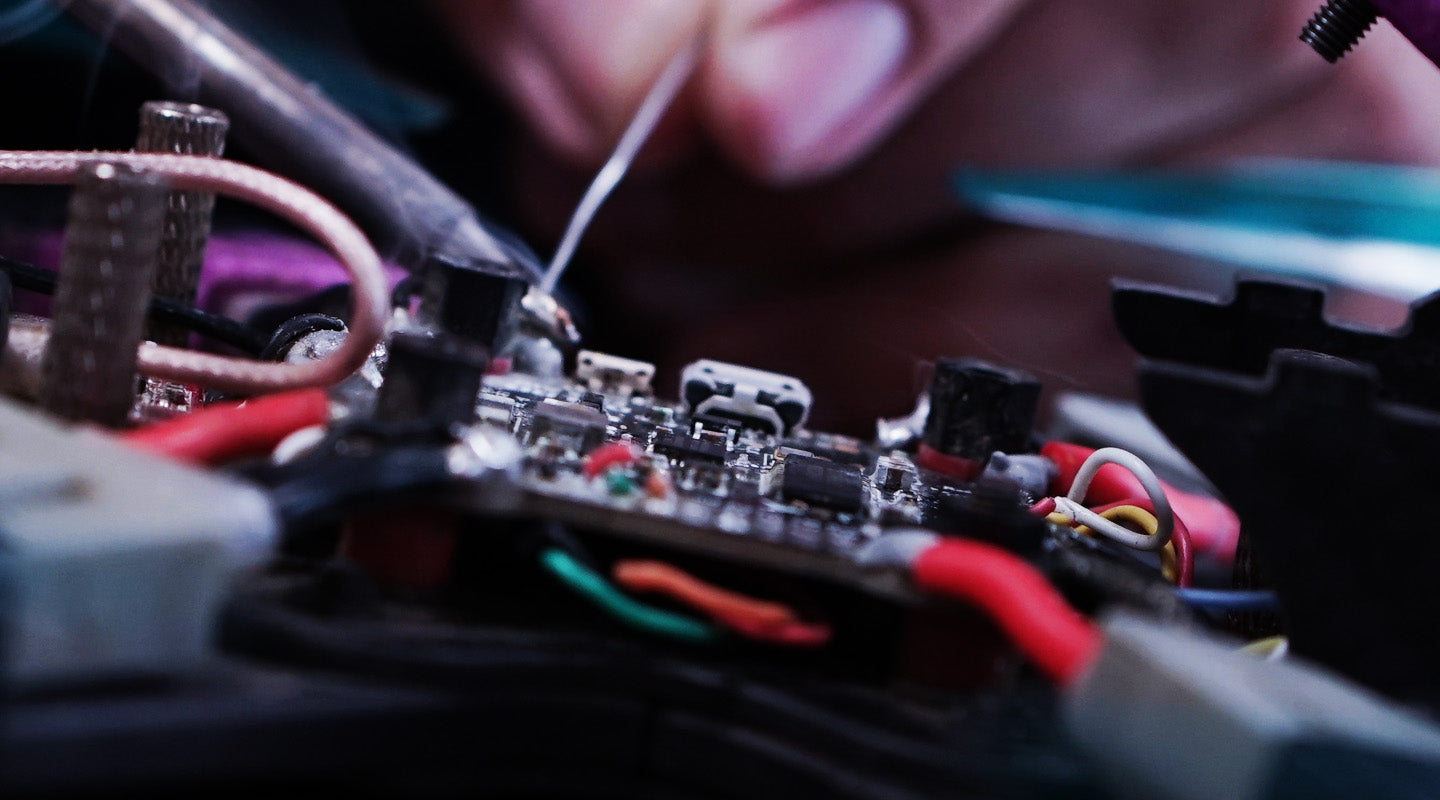
The Flight Controller (FC) is the central unifying component of a drone. You can think of it as the "brain" and it is able to communicate with every other device attached to the drone.
It processes the commands from the pilot and translates everything into separate instructions to each motor. It also features a sensor called a gyroscope. Gyroscopes help the drone maintain orientation and corrects for turbulence, wind, drifting, and other external or environmental factors.
Some FCs are also able to process video signals. This allows them to overlay visual performance data atop the live video that’s being streamed to the pilot's goggles, such as battery voltage, signal strength, etc.
There are many flight controller options available, each with different features.
The FPV System
The components we’ve discussed above will allow stable flight. But the most fun you can have with a drone, the real magic of the FPV Experience, lies in the FPV system.
Currently, there are two types of FPV systems: digital and analog FPV Systems. While there are big differences between the two systems, we will focus on the similarities for now.
Even the most basic FPV system usually boils down to these components:
The FPV Camera

The FPV Camera sits at the front of the drone, acting as your virtual eyes. It captures real-time video and sends it to the Video Transmitter.
In the past, these cameras were low-resolution However, modern Digital FPV cameras (like the DJI or Walksnail FPV systems) are hybrids that can stream video to your goggles and record high-definition 4K video simultaneously.
Despite this, many pilots still mount a separate Action Camera (like a GoPro or Insta360) on top. Dedicated action cameras generally offer superior image stabilization (using tools like Gyroflow) and higher recording quality for professional cinematic work.
FPV Cameras bought by themselves are usually analog, unless otherwise stated.
The Video Transmitter
The Video Transmitter converts the video signals from the camera into wireless signals. The Video transmitter has an antenna that transmits these wireless signals to the pilot’s FPV Goggles.
A high quality Video Transmitter is recommended for the best experience.
The Ground Equipment
The Remote

The Remote is what the pilot uses to give commands to the drone. The drone’s remote usually has two control sticks, which offer precise piloting control, and a few switches or buttons that can be configured to perform certain functions on the drone.
Try to get a controller that fits in your hands comfortably.
The FPV Goggles

The Goggles are probably the most important part of a great FPV Experience. They have an antenna that receives the wireless video signals from the drone and a video screen that displays the video feed that’s streamed from the FPV camera.
There are other devices that are able to receive and display the FPV video feed, such as small monitors, but since goggles are mounted close to your face and block the visibility of your surroundings, they provide an unmatched level of immersion.
There's a wide range of goggles for every budget.
The Gear, Equipment & Tools

The stuff we’ve gone over is all you need to fly, but before you can head out to fly again, you’ll need a good Charger that’s capable of recharging your LiPo batteries. There are many ways to go about charging batteries, but we won’t go deep into that in this article.
When it comes to building or repairing your drone, you’ll need some basic tools. Here are the essentials:
- Quality Hex Drivers are required to assemble most frames. The most common sizes are 1.5mm, 2mm, and 2.5mm.
- A good soldering iron, along with some solder and flux, will allow you to connect certain components that do not use plug-in connectors, such as the motors.
- A propeller tool will let you install, replace, or remove propellers. For most standard-sized FPV drones, this would be a M8 nut driver.
That covers the essentials, but there are many tools, gear and accessories that can improve your experience. A good example is a bag or backpack to carry your gear safely - not essential, but definitely practical!
How do I get into FPV drones?
So you’ve learned a thing or twenty about FPV Drones, and now you want to get your own. But where should you start?
Start with a FPV Drone Simulator!
If we could only make one recommendation for your journey into FPV Drones, it would be this: Use an FPV simulator first.
An FPV simulator is a computer game that allows you to try FPV piloting virtually, with or without a controller, before investing in brand new FPV equipment. With a simulator you can practice for hours, trying new moves, learning new skills-- and crash hundreds of times without having to buy a single replacement part.
It’s a good idea to fly at least 5 hours in the simulator before going for the real thing. You’ll thank us later! Our favorite simulator is definitely Liftoff FPV Simulator!
We recommend getting a drone controller that you can use with the simulator. This way you’ll be able to train your fingers' muscle memory, ultimately making the transition from simulator to real FPV flight as smooth and easy as possible.
Ready To Transition To Real-World FPV Flying?
Let us help you get into FPV
We love FPV Drones, and we’d love to help you get into FPV Drones too! Our professional support staff is is ready to help you set up your own FPV Experience!